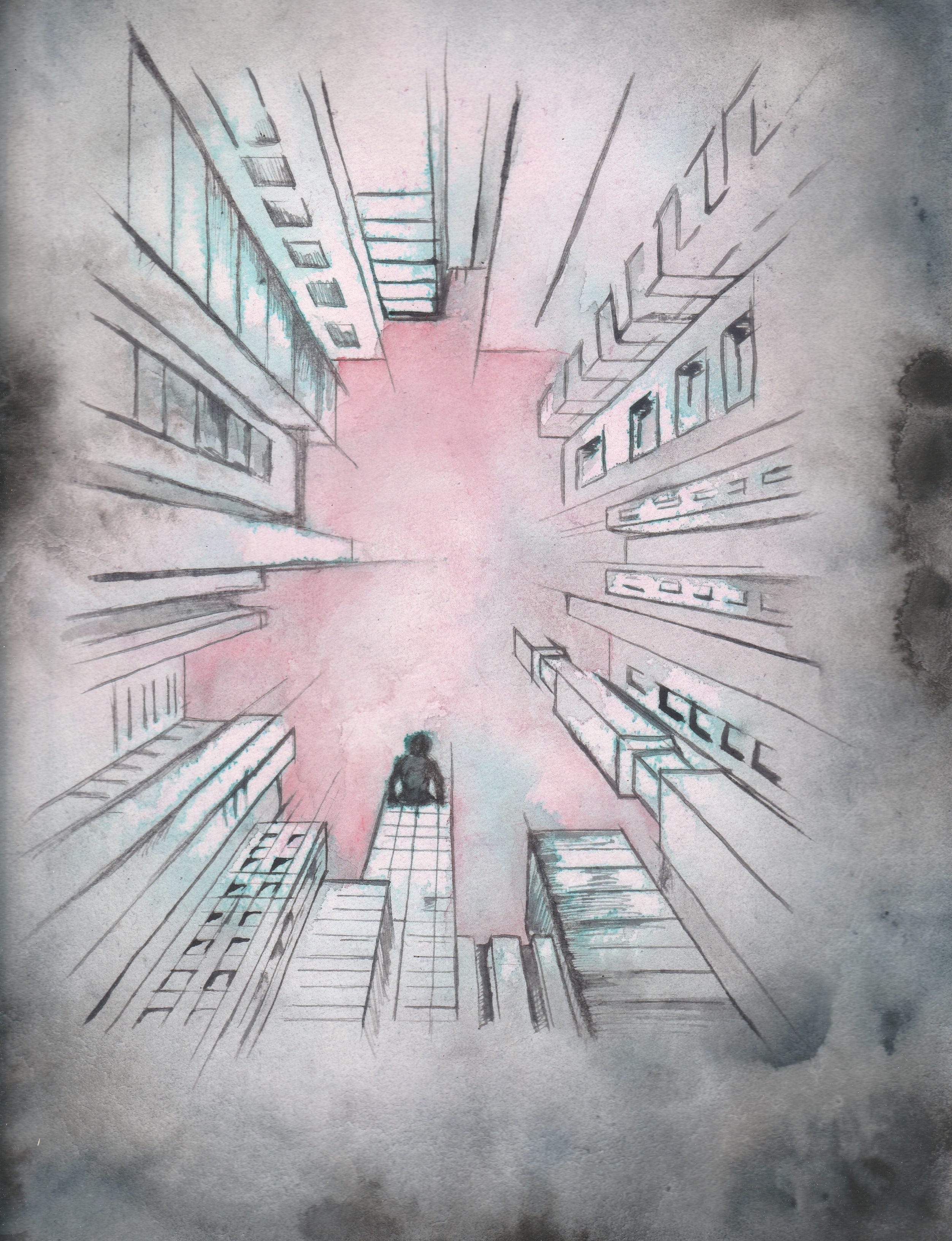
Foto: Oryanna Borges
The homeland is commonly referred to as the motherland. Considered more than a nation, the motherland serves as our genesis and primary dwelling. In some respects, our connection to the land we inhabit parallels the initial bond with our first environment: the maternal womb. The gestational environment that sheltered me was, however, inflexible. Limited nutrition and elevated levels of cortisol and noradrenaline predisposed me to a state of hypervigilance. This pattern of relating extended to the urban environments I subsequently inhabited. In 2012, upon my initial engagement with urban life, I returned to Curitiba after a nine-month absence, feeling orphaned despite my mother's continued existence. Grief for a living parent is an anomaly, offering a unique challenge to comprehension, which poetry perhaps best articulates. Returning with increased personal experience, the sensation of alienation persisted. Nevertheless, I re-established my presence, possessing a heightened awareness of both myself and the emotional detachment that characterized our relationship. I consistently perceived the cities I inhabited as adversarial entities. Similar to my mother, they demanded diligent and continuous effort in exchange for a meager sustenance. My native land was a crucible of red earth and individuals bearing similar hardships. Observing a citizen in pristine white sneakers or conspicuously clean white Havaianas flip-flops, I often pondered how they achieved such an appearance of cleanliness, devoid of the indelible purple stain that perpetually marked others' social standing.
The Foz do Iguaçu of my childhood presented as a melancholic maternal figure, passively observing her children's play in the dirt, perhaps hoping that the joys of youth might distract them from their hunger. Sustenance was limited to three daily meals for the offspring, and on sweltering afternoons, children were left to satiate their hunger with sunlight and youthful exuberance – experiences I did not share.
Conversely, the Curitiba of my adolescence manifested as a cold maternal influence, capable of subjecting her young female inhabitants to unproductive labor and the predatory desires of men driven by avarice for wealth, land, and virginity. As a formidable adversary, this cold maternal entity compelled me to articulate myself. I, who lacked the ability to voice my thoughts, hesitantly spoke my initial words and began to assert my physical presence. I developed a tangible existence, a resilience that strengthened with adversity. Consequently, to avoid a similar hardening as the restrictive womb of my origins, I chose not to bear children within this environment. Curitiba did not receive my progeny as a gesture of reconciliation, to be molded by its accent and customs. Our sole connection was a modest dwelling of approximately sixty square meters, which I designated as home. This space, however, was reclaimed with the same detachment with which my mother witnessed my three departures from our familial home. Just as I had fled my birthplace of red soil, I intended to escape the bleak disappointment of my aspirations in Curitiba, but the city amplified my sense of exile, transforming it into a spectacle for the amusement of other adversaries.
However, while Curitiba represented a cold maternal figure, the poem "Implicâncias de Aniversário" (Birthday Bickering) embodies the expression of an unsubmissive lyrical self. The assertion of individuality and resistance to oppression forms the core of this urban dialogue.
The pursuit of autonomy and integrity would span over a decade. Ultimately, Curitiba reclaimed what it considered its own, and I retained what I had cultivated within myself, akin to a daughter secure in her position as a natural heir. Only my self-developed attributes remain intrinsically mine. These I carried to a new urban center: São Paulo. This city, like myself, exists in extremes. Between these extremes lie the extensive shadows cast by buildings and implicit warnings to exercise caution in less frequented pathways. My respiratory system reacts negatively to the pervasive soot that, when not inhaled, accumulates as a dark film on the rough surfaces of the furniture in my high-rise refuge. I experience a sense of security at this elevation, with my deliberately short hair. I understand that my presence here is transient. The city, however, recognizes that my self-development is being transformed into written expression, and I will not depart without some form of material gain.
São Paulo has proven to be a considerate host, despite the elevated cost of coffee and the fact that its concrete surfaces do not yield agricultural produce, which are priced exorbitantly as if imported from a distant, idealized land. Only my poetic verses remain inexpensive, their low cost attributed to the borrowed illustration from another poet's work. "Tons de Cinza" (Shades of Gray), by Ruy Villani, conversely, speaks of belonging and claiming the native land through the pathways of memory. I, however, possess no such memories of home, only recollections of becoming lost in dreamlike landscapes. Now, perceiving the truth that emerges from the subtle flaws and resides in transitional spaces, those ambiguous areas, I recognize that just as Ruy contemplates eternity and inevitable departure in "Tons de Cinza," I aspire to return to a sense of home, contemplating a similar image. Home, however, resides within me. I am my own home, a structure of words built upon the shifting sands of time.